
Juliana Systems Limited · Edition 1 · November 2026
Economic Intelligence, Economic Life and the Average African Operator
Publication Information
The Intellectual Foundations of Juliana
Economic Intelligence, Economic Life and the Average African Operator
Publisher
Juliana Systems Limited
Edition
Edition 1
Publication date
November 2026
Authoring attribution
Juliana Systems Limited — Research and Strategy
Company registration
RC 8931026, Nigeria
Official website
julianaplatform.com
Research library
julianaplatform.com/research
Publication status
This is an official Juliana Systems Limited intellectual and institutional publication. It sets out the company’s foundations concerning Economic Life, Economic Intelligence, Economic Infrastructure, Economic Control, the Average African Operator and the architectural direction of Juliana.
Copyright
© 2026 Juliana Systems Limited. All rights reserved.
This publication may not be reproduced, distributed or adapted in whole or in part without written permission from Juliana Systems Limited.
Executive position

Juliana Systems Limited is an Economic Intelligence Company building an intelligent operating system for African Economic Life.
Economic Intelligence is the reason Juliana exists. Economic infrastructure is the enabling layer through which intelligence engages with Economic Life. Accounts, wallets, payments, records, workflows, permissions, products, services, customers, staff, websites and operating capabilities matter because they give Economic Life structure, produce reliable activity and create the conditions for qualified understanding.
Juliana’s governing proposition is direct: the Average African Operator does not need more disconnected tools added to an already complex life. The operator needs intelligent systems that reduce chaos, explain what is happening in plain English and restore the ability to see, understand, direct and coordinate the economic reality they carry.
The governing architecture at a glance

Governing layer | Institutional meaning | Role in Juliana |
|---|---|---|
Economic Life | The connected reality of what people and organisations earn, operate, own, owe, plan, protect and build toward. | The subject Juliana exists to understand. |
Economic Infrastructure | The financial, commercial, operational, technological, trust and execution systems that structure activity. | The enabling system that makes intelligence possible. |
Economic Intelligence | The capability to capture, structure, interpret, connect, qualify and reason about economic activity and context. | The reason for the platform and the governing company category. |
Economic Control | The operator’s growing capacity to see, understand, direct, coordinate and act within their authority. | The human outcome Juliana is designed to make more possible. |
Contents
Section | Intellectual foundations within the section | Summary meaning |
|---|---|---|
Section 1: Economic Life and the Average African Operator | Economic Life; Economy; Average African Operator; Economic Activity; Economic Infrastructure; Personal Economy; Business Economy; non-linear economic reality. | Defines the subject Juliana exists to understand and the human reality across which intelligence must operate. |
Section 2: Economic Intelligence and Economic Control | Economic Intelligence; Economic Control; the governing relationship; operator primacy; sovereign economic contexts; structured complexity; human authority. | Establishes why Economic Intelligence is the governing capability and why infrastructure exists to enable it. |
Section 3: Sense Intellectual Foundations | Sense™; the Tri-Force Model™; Intelligence Democracy; Truth → Clarity → Confidence → Control → Freedom; Control as a movement; Intelligence Doctrine; operator loop. | Defines how Juliana makes, qualifies, explains and delivers Economic Intelligence. |
Section 4: Foundations of Economic Intelligence | Economic Understanding; Analytical and Quantitative Intelligence; Computational and Artificial Intelligence; Systems and Decision Intelligence; Research, Knowledge and Evidence. | Classifies the disciplines and subpillars that give Economic Intelligence intellectual depth and operational discipline. |
Section 5: Foundations in Application and the Juliana Innovation | Architectural Unification; Adaptive Economic Intelligence; Cross-Domain Intelligence; Progressive Authorised Execution; African-First Economic Infrastructure. | Shows how the foundations become an applied system designed to make greater Economic Control possible. |
Section 6: The Economic Intelligence Framework | Manifestation Matrix; Economic Control Model; New Economic Model. | Defines the principal dimensions, outcomes and transformation logic of Economic Intelligence. |
Section 7: Sense Architecture and Intelligence Domains | Sense architecture; Sense Intelligence; Sense Experience; PersonalSense™; BusinessSense™; Smart Assistant™; Sense Cards™; SenseMoment™; JMI™; SuperSense™; Advanced SuperSense™. | Explains how the framework becomes an event-driven architecture, intelligence domains and user-facing capability. |
Section 8: Economic Environments and Platform Mechanisms | Personal Economy; Business Economy; Adaptive Business OS; Unify™; Mode Switch™; Unlock Your Business™; Unlock Ladder. | Defines the environments and mechanisms through which Economic Life becomes structured and intelligible. |
Section 9: Translation into Operator Value | Research; philosophy; conceptual modelling; architecture; infrastructure; intelligence production; experience; action; outcomes; feedback. | Traces how Juliana’s intellectual position becomes capability and everyday operator value. |
Institutional Discipline and Interpretation | Evidence versus proposition; concept versus implementation; architecture versus experience; present capability versus future direction; terminology governance. | Sets the discipline by which Juliana communicates, builds and evolves its intellectual foundations. |
Ultimate Institutional Statement | Economic Life; Economic Infrastructure; Economic Intelligence; Economic Control. | States the complete institutional proposition in its most concentrated form. |
Juliana Intellectual and Value Architecture | Research; philosophy; architecture; infrastructure; intelligence; experience; control; value. | Presents the complete relationship between Juliana’s intellectual foundations and intended economic value. |
Closing Position | Corporate identity; research continuity; platform direction; institutional confidence. | Closes the document with Juliana’s continuing position as an Economic Intelligence Company. |
SECTION 1: Economic Life and the Average African Operator
The Average African Operator

The Average African Operator is Juliana’s central human concept. The term describes the person who carries economic responsibility across overlapping roles, income sources, commitments, ventures and decisions. They may be earning from employment, operating a venture, providing a service, selling products, supporting a household, building assets, investing, creating value or preparing a new opportunity at the same time.
The Average African Operator is not a single demographic stereotype. It is a structural reality: one person carrying an interconnected Economic Life across systems that rarely share context. Their economic identity is active, multi-role and changeable. They can move between roles without their obligations, pressures or opportunities waiting for the systems around them to catch up.

Operator type | Core economic expression | What the intelligence environment must understand |
|---|---|---|
Retailer | Sells physical or digital products. | Product movement, stock, orders, customers, collections, demand and commercial performance. |
Service Provider | Provides services and manages bookings or delivery capacity. | Availability, bookings, customer commitments, delivery, payment and repeat demand. |
Professional | Delivers expertise through engagements, appointments or client relationships. | Client commitments, workload, invoices, receivables, delivery risk, trust and professional capacity. |
Active Earner | Earns through employment, contracting, commissions, informal work or multiple income sources. | Income timing, obligations, liquidity, earning stability, capacity and personal economic pressure. |
Creator | Produces intellectual, creative, digital or cultural value through audiences, projects or commercial opportunities. | Project flow, audience activity, income sources, commitments, assets, rights and future opportunity. |
Hybrid Operator | Combines products, services, employment, ventures or multiple economic roles. | The relationships between personal and business activity, product demand, service capacity, commitments, resources and authority. |
These types cut across Personal Economy and Business Economy. They are not mutually exclusive account categories. They are operating expressions through which the same person may carry Economic Life at different times or simultaneously.
The two economic environments

Environment | Full scope | Governing intelligence question |
|---|---|---|
Personal Economy | Finance, Investments, Assets and Lifestyle: what the operator earns, receives, holds, spends, owes, invests, owns, protects, plans and builds toward. | What is happening across the operator’s personal economic states, what is changing, what matters and what follows? |
Business Economy | Retail, service, professional, hybrid and multi-venture operations: products, services, customers, bookings, orders, inventory, invoices, payments, staff, permissions, websites, locations, expenses, growth and visibility. | What is happening across the operator’s operating reality, what is connected, what requires attention and what can be coordinated? |
Personal Economy and Business Economy remain structurally distinct environments with their own records, permissions and operating logic. They are connected through the operator’s wider Economic Life and through governed context. Intelligence becomes more useful when it understands the relationship without collapsing the environments.
Before defining Juliana’s architecture or products, it is necessary to establish the subject around which the entire system is organised.
Economic Life
Definition
Economic Life is the totality of economic activities, resources, relationships, responsibilities, obligations, decisions, opportunities and outcomes through which an individual or organisation participates in economic existence.
It encompasses how people earn, receive, hold, spend, transfer, invest, build, operate, exchange, provide, consume, grow, manage obligations and create economic possibilities.
Economic Life extends beyond financial transactions. It includes the commercial and operational activities that give economic activity meaning and direction.
For an individual, Economic Life may include income, personal finances, assets, investments, bills, commitments, lifestyle, goals and future plans.
For a business operator, it may include revenue, customers, products, inventory, services, employees, bookings, collections, suppliers, expenses, obligations and growth.
These activities are not necessarily independent. They can influence one another, share resources, create dependencies and produce consequences across different parts of an operator’s life.
Why it matters to Juliana
Economic Life is the subject Juliana seeks to understand.
It establishes the scope of the problem beyond individual banking transactions or isolated business workflows. It provides the conceptual basis for bringing personal, financial, commercial and operational realities into an intelligent operating environment.
Juliana does not seek to reduce Economic Life to a single account, application or activity. It seeks to provide systems capable of carrying and understanding more of its complexity.
Economy
Definition
An Economy is an organised environment of economic activity, resources, participants, relationships, exchanges, responsibilities and outcomes.
It is the environment within which economic value is created, held, moved, exchanged, managed and developed.
An economy is not limited to a national or geographical economic system. At the platform level, it can also describe the organised economic environment through which an individual or business operates.
Why it matters to Juliana
The concept of Economy allows Juliana to organise Economic Life into meaningful operating environments.
Personal Economy and Business Economy are the platform’s two primary economic environments. They represent different economic realities, operating requirements, relationships, records and authority structures.
They are connected through the operator and the wider Economic Life they participate in, but they must retain appropriate separation of data, permissions and operating logic.
The Operator
Definition
The Operator is the individual or organisational actor who participates in, manages, influences and makes decisions within Economic Life.
The operator may be an individual managing personal finances, a business owner, a professional, a retailer, a service provider or someone carrying multiple economic roles simultaneously.
Why it matters to Juliana
The operator is the fundamental human unit around which the platform’s value is organised.
Juliana recognises that the same individual may operate across multiple economic environments and responsibilities. Someone may be an employee, entrepreneur, investor, service provider, household financial manager and business owner at the same time.
These identities may be distinct, but the economic realities they generate can be related.
The platform must therefore be capable of supporting multiple economic roles without assuming that all associated records, permissions or contexts should be merged.
Economic Activity
Definition
Economic Activity is any action, event, transaction, commitment, exchange, operation or occurrence that creates, changes, transfers, consumes, manages or affects economic value or an economic condition.
Examples include:
Receiving income.
Making payments and transfers.
Purchasing products or services.
Issuing and settling invoices.
Receiving customer orders.
Managing inventory.
Delivering services.
Booking appointments.
Paying employees.
Acquiring assets.
Managing obligations.
Making commercial and financial decisions.
Economic Activity generates the events and records through which Economic Life can be represented and understood.
Why it matters to Juliana
Economic Activity is the bridge between Economic Life as a broad human reality and Economic Intelligence as a system capability.
The platform must be able to capture meaningful activity, establish reliable records, understand relationships between events and interpret the context surrounding them.
Without structured activity, there is insufficient reliable material from which to develop meaningful intelligence.
Economic Infrastructure
Definition
Economic Infrastructure is the collection of financial, commercial, operational, technological, trust and execution systems that enable economic activity to occur, be recorded, managed and acted upon.
It includes the systems through which economic value is held and moved, commercial activity is organised, responsibilities are distributed, records are maintained and authorised actions are executed.
Why it matters to Juliana
Economic Infrastructure is the foundation through which Juliana engages with Economic Life.
It provides the operational conditions required to capture and structure economic activity.
This includes wallets, accounts, payments, transfers, invoices, inventory, bookings, products, services, customers, staff, websites, permissions, authentication and execution pathways.
Infrastructure is essential, but it is not the full company proposition.
Juliana’s ambition extends beyond enabling activity. It seeks to understand the activity, interpret its meaning and progressively support better-informed decisions and action.
The distinction:
Economic Infrastructure enables and structures economic activity.
Economic Intelligence interprets and makes that activity increasingly understandable and actionable.
SECTION 2: Economic Intelligence and Economic Control
Juliana’s philosophical establishments provide the governing ideas through which its platform, architecture and product decisions are understood.
They establish the company’s worldview, the nature of the problem it addresses, the type of system it seeks to build and the human outcome it considers important.
Economic Intelligence
Definition
Economic Intelligence is the capability to capture, structure, interpret, connect, evaluate and reason about economic activity and its surrounding context in order to produce meaningful understanding and support informed decisions and authorised action.
It involves more than access to financial information or the recording of transactions.
It requires the ability to understand what is happening, identify meaningful relationships, interpret conditions, establish evidence, communicate significance and progressively support the operator in responding to economic realities.
Why it matters to Juliana
Economic Intelligence is Juliana’s governing capability and central institutional identity. It explains the relationship between infrastructure, structured activity, context, permissions, architecture and experience: each layer exists to make economic reality more intelligible and actionable. Economic Intelligence therefore provides the organising logic for platform evolution.
Economic Control
Definition
Economic Control is the operator’s capacity to understand, influence, direct, coordinate and make informed decisions about the economic realities within their sphere of responsibility and authority.
It involves visibility, awareness, clarity, judgement, foresight, coordination, agency and the ability to act within available resources and legitimate authority.
Economic Control does not mean absolute control over economic outcomes. Economic conditions remain subject to uncertainty, external forces, market behaviour and circumstances beyond an operator’s authority.
Rather, it describes a stronger relationship between the operator and the economic realities they must navigate.
Why it matters to Juliana
Economic Control is the intended human outcome of Juliana’s Economic Intelligence proposition.
The platform seeks to reduce the burden of fragmented economic management and improve the operator’s ability to understand their position, recognise what matters, make decisions and coordinate activity.
Economic Intelligence is valuable not merely because it produces information, but because that information can improve the operator’s understanding and capacity to act.
The relationship between Economic Life, Economic Intelligence and Economic Control

These three ideas establish the fundamental logic of Juliana:
Economic Life is what Juliana seeks to understand.
Economic Intelligence is the capability Juliana develops to understand it.
Economic Control is the human outcome Juliana seeks to enable.
Economic Infrastructure provides the foundation through which Juliana engages with Economic Life and obtains the structured activity and context required for intelligence.
The governing progression is: Economic Life → Economic Infrastructure → Economic Activity and Context → Economic Intelligence → Greater Economic Control. The remaining architecture gives this progression operational form.
Juliana’s Principles
Juliana’s principles are the foundational rules of thought that guide research, product development, architecture, innovation and future platform decisions.
They are not merely communication statements. They provide a basis for evaluating whether a product decision or architectural direction is consistent with the company’s worldview.
The following principles govern Juliana’s research, architecture and platform decisions.
The operator is the fundamental economic unit
The platform begins with the individual or organisation participating in Economic Life.
Systems are organised around the realities of the operator rather than forcing operators to organise their lives around disconnected software categories.
Economic Life is multi-role and increasingly composable
An individual can participate in multiple economic roles simultaneously.
The platform must accommodate the relationships between these roles while preserving appropriate context, identity, authority and separation.
Business is an operating environment, not a software category
A business is not simply a collection of administrative tools.
It is an operating economic environment involving customers, revenue, products, services, inventory, employees, commitments, resources, decisions and obligations.
Personal and Business are sovereign economic contexts
Personal Economy and Business Economy have distinct economic realities, records, operating logic and authority requirements.
Their relationship must not eliminate the boundaries that protect each environment.
Unified intelligence does not require unified data state
Relevant contexts may inform broader intelligence without requiring unrestricted access to all underlying records.
Intelligence must respect permissions, purpose limitations, mode boundaries and applicable privacy controls.
Intelligence requires structure and context
Information alone is insufficient.
Meaningful intelligence requires reliable activity records, relevant relationships, source provenance, temporal context, interpretation and evidence.
The system should carry economic complexity
The platform should absorb and organise complexity rather than transferring the entire burden of coordination and interpretation to the operator.
Control is a system property, not a discipline burden
Greater Economic Control should emerge from better infrastructure, visibility, intelligence, coordination and authority.
It should not depend entirely on the operator manually maintaining fragmented systems.
Human authority remains above system execution
Systems may interpret, recommend, prepare and execute authorised work within defined boundaries.
The authority to approve, direct or override consequential actions must remain governed by explicit permissions and controls.
Sophisticated infrastructure should be ordinary
Complex systems should translate into accessible, reliable and understandable experiences.
Operators should benefit from sophisticated underlying capabilities without having to understand the full technical complexity.
The future pulls the architecture forward
The platform should be designed with a clear understanding of the capabilities it intends to develop.
However, future ambitions must not be presented as current capabilities or allowed to compromise present-day reliability.
The purpose of capability is possibility
Technology and infrastructure are valuable because of what they make possible for people and businesses.
The purpose of building more capable systems is to expand the operator’s ability to understand, coordinate, decide, act and progress.
Personal Economy is a state-based environment
Personal Economy is organised across the connected states through which an operator carries personal Economic Life: Finance, Investments, Assets and Lifestyle. These states are distinct expressions of one personal economy. Finance represents current flows and position; Investments represent future value and capital deployment; Assets represent ownership, use and productive capacity; Lifestyle represents commitments, affordability, goals and the way the operator lives.

The states are not a rigid sequence. An operator may move between them continually, and activity in one state may alter the conditions of another. Personal Economy therefore requires continuity across states while preserving the meaning of each state.
Business Economy is adaptive to operating reality
Business Economy is an adaptive operating environment. It recalibrates its relevant structures around the operator’s actual expression of economic activity. The core operating expressions are Retailer, Service Provider, Professional and Hybrid Operator, while an operator may also be an artisan, creator, active earner, employee, investor, venture builder or manager of multiple ventures.

The platform’s value is not defined by forcing every operator through one linear business model. It is defined by giving the operator a coherent Business Economy that can accommodate products, services, bookings, orders, inventory, customers, invoices, payments, staff, permissions, websites, visibility and operational responsibilities according to the reality being carried.
Economic Life is non-linear
The Average African Operator does not necessarily move through one clean economic path. They may work somewhere, operate a growing business, sell products, provide services, manage a household, support dependants, pursue a professional practice, test a new venture and build assets at the same time. Their personal and business realities may expand, contract, overlap and change expression over time.

Juliana’s architecture recognises this non-linearity as a primary design condition. Personal Economy and Business Economy remain distinct environments, but the operator’s wider Economic Life remains coherent across them. Intelligence must therefore understand changing roles, states, relationships, commitments and authority without collapsing the environments that require separation.
Economic Intelligence is the governing capability
Economic Intelligence is the basis for Juliana’s existence. Every environment, infrastructure layer, record, experience and workflow is evaluated by the intelligence it makes possible: what can be seen, understood, connected, qualified, prioritised, explained, decided, coordinated or safely authorised.

Economic infrastructure is therefore organised in service of intelligence. It gives Economic Life structure and creates the conditions through which Sense™ can produce qualified understanding and progressively support Economic Control.
The preceding foundations define the subject, the operator and the governing capability. The framework below now gives Economic Intelligence a formal set of dimensions, outcomes and transformation logic.
SECTION 3: Sense Intellectual Foundations
Sense™ is the Economic Intelligence architecture of Juliana. It is the system through which structured activity becomes qualified understanding and through which that understanding reaches the operator.
The Tri-Force Model™
Part | What it is | What it answers |
|---|---|---|
Sense™ | The Economic Intelligence framework that captures, structures, interprets, reasons about, coordinates and enables authorised action. | How is intelligence made? How does Juliana know? |
Sense Intelligence™ | The qualified intelligence output: insights, signals, metrics, confidence, priority, maturity, provenance and language. | What intelligence has been produced? What does Juliana know? |
Sense Experience™ | The operator-facing centers, assistants, cards, conversations, notifications, panels, moments and action surfaces through which intelligence is understood and used. | How does the operator meet, understand and act on intelligence? |
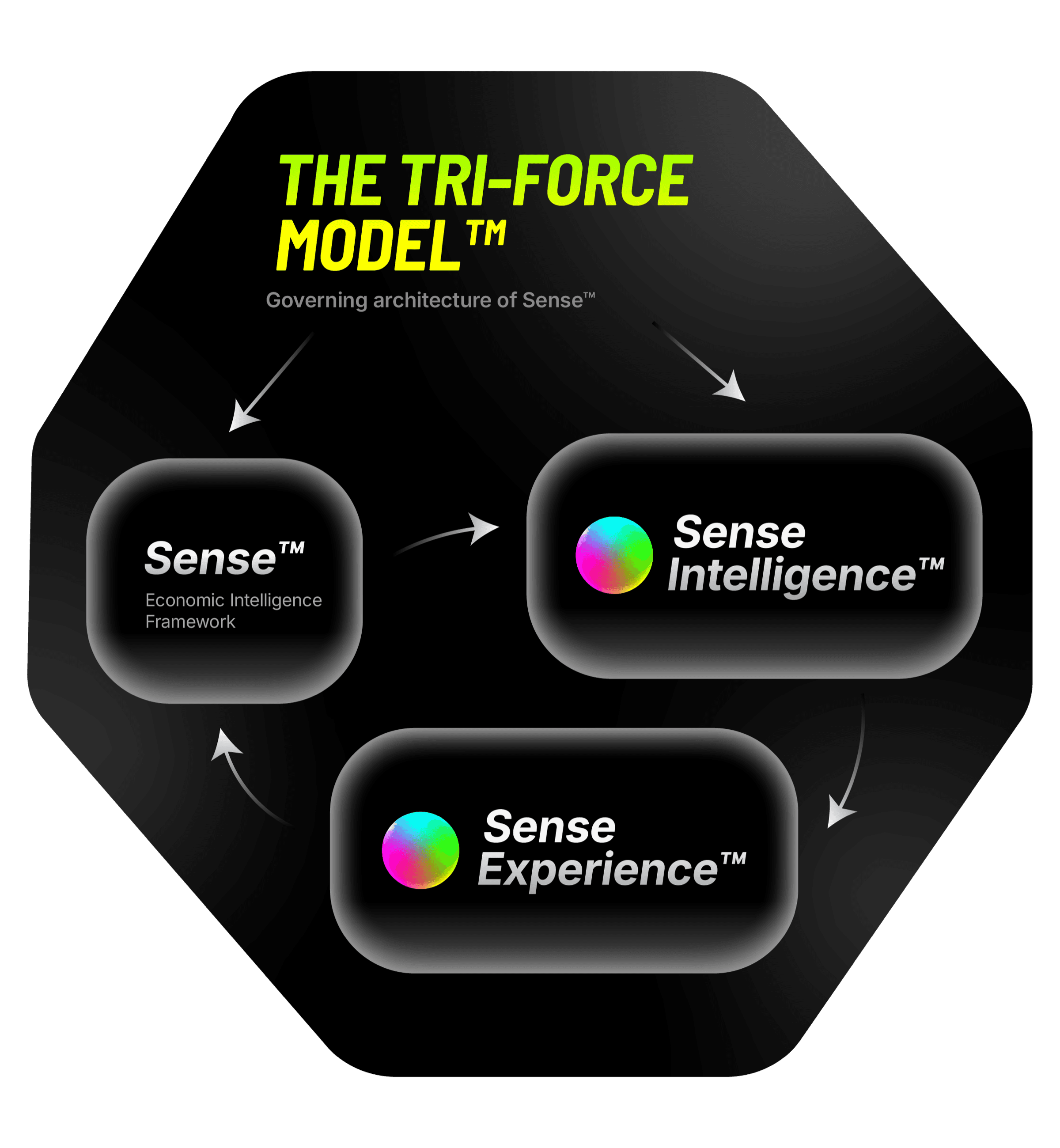
Sense makes intelligence. Sense Intelligence is the qualified output. Sense Experience puts it in the operator’s hands.
The governing Sense principle
Truth creates clarity. Clarity creates confidence. Confidence creates control. Control creates freedom.
The standard of intelligence is not the volume of output. The standard is whether the operator gains a clearer, more truthful understanding of their Economic Life. Intelligence is meaningful when it reduces unnecessary reconstruction, identifies what changed, explains why it matters and makes the next authorised step more intelligible.
Intelligence Democracy
Africans get the real intelligence, in plain English, not a simplified version. Intelligence Democracy is the institutional belief that contextual understanding should not be reserved for organisations with larger teams, better records or stronger analytical infrastructure. The Average African Operator deserves access to the same seriousness of interpretation, expressed in language that can be understood, questioned and used.
The core belief is direct: Africans do not need more tools. They need intelligent systems that reduce chaos and restore control.
Control as a movement
Control is not a static dashboard state. It is a movement through which the operator’s relationship with Economic Life becomes stronger:
Movement | What changes for the operator |
|---|---|
Activity to record | Economic events become reliably represented rather than held only in memory, notebooks or scattered systems. |
Record to context | The operator can see the surrounding conditions, relationships, timing and state that give an event meaning. |
Context to truth | The system distinguishes what is known, what changed, what is supported and what remains uncertain. |
Truth to clarity | The operator understands the significance of the condition without reconstructing it from fragments. |
Clarity to confidence | The operator can judge with a stronger basis and less cognitive carry. |
Confidence to coordination | The operator can direct money, work, people, obligations and attention more deliberately. |
Coordination to control | The operator gains a stronger capacity to manage the Economic Life within their authority. |
Control to freedom | Better understanding creates more room to choose, recover, build and pursue possibility. |
Sense Intelligence Doctrine
The intelligence doctrine governs how Juliana produces, qualifies, communicates and progressively expands Economic Intelligence.
Doctrine | Institutional rule |
|---|---|
Deterministic first | Phase 1 intelligence is built on SQL, event records, projections, materialised views and deterministic rules. Phase 1 does not depend on machine learning. |
Traceability | Every intelligence output can show the source events, records, calculations and contextual inputs that produced it. |
No fabrication | Missing data is named, never filled by invention. The output identifies the unavailable fact and the action that would generate it. |
Relative to self | Operators are compared with their own history, baselines and stated context, never with other users. |
Behaviour, not character | Language describes observed behaviour and evidence: “pattern detected”, never “you always”. |
Confidence framework | Confidence is scored from sample, consistency and recency. Bands are 0–39 suppressed, 40–59 teaser, 60–79 emerging and 80+ confirmed. Floors apply by intelligence type. |
Signal sufficiency | Every output has a minimum evidence requirement. Insufficient evidence suppresses the output or changes it to an appropriately limited statement. |
Anomaly is deviation, not verdict | A deviation is identified as a difference from a relevant baseline. Variance is not automatically good or bad. |
Valence separate from wording | Calculation, interpretation and copy are separated. The card copy engine does not turn a neutral deviation into a positive or negative judgement without evidence. |
Redirect, do not reject | Out-of-scope questions are redirected to the nearest answerable question instead of producing an unhelpful refusal. |
The nine behavioural rules
Rule | Governing behaviour |
|---|---|
Rolling windows | Signals are evaluated over defined windows appropriate to the event and intelligence type. |
Signal classes | Identity, activity, pattern and anomaly signals retain distinct meanings and handling. |
Level determination | The system determines the appropriate output level from evidence, context and the operator’s state. |
Confidence | Scores are calculated from sample, consistency and recency and are checked against the relevant floor. |
Pattern validation | A pattern requires repeated, sufficiently consistent evidence rather than one isolated event. |
Anomaly detection | An anomaly is a qualified deviation from a baseline, not an automatic conclusion about the operator. |
Language guardrails | Copy remains plain, evidence-bound, non-judgemental and explicit about uncertainty. |
Historical calibration | Baselines evolve from the operator’s own valid history and do not become arbitrary comparisons. |
Explainability | Each surfaced output can explain what it observed, how it interpreted it and why it is being shown. |
Sense and the operator loop
Stage | What occurs |
|---|---|
Activity | The operator earns, spends, transfers, sells, books, delivers, collects, manages or changes an economic condition. |
Sense | The activity is captured as structured, mode-scoped events with context and provenance. |
Sense Intelligence | The framework qualifies the signal, applies evidence thresholds and produces an intelligible output. |
Sense Experience | The output appears through the relevant center, card, conversation, notification, panel or SenseMoment™. |
Operator response | The operator views, questions, dismisses, shares, decides or acts. |
New evidence | The interaction and resulting action become new events that inform frequency control and later behavioural learning. |
SECTION 4: Foundations of Economic Intelligence
Economic Intelligence is a multidisciplinary field of understanding and capability. Its development draws upon economic sciences, behavioural and cognitive sciences, mathematics, statistics, data science, computational science, artificial intelligence, systems science, complexity theory, operations research, decision science, information science, knowledge engineering and research methodologies, among other relevant disciplines.
These foundations contribute different but complementary forms of understanding, measurement, interpretation, reasoning, evidence, computation and decision support. No single discipline or technology independently constitutes Economic Intelligence.
Economic Intelligence is multidisciplinary in its foundations, integrated in its architecture, technological in its implementation and economic in its purpose. Its governing purpose is to understand Economic Life and enable greater Economic Control.
Institutional status of the foundations
The five pillars are Juliana’s institutional classification of the knowledge domains, analytical methods, computational capabilities, systems disciplines and evidence practices that contribute to Economic Intelligence. They are not five equivalent academic sciences, and their inclusion does not imply that every capability has already been implemented in the platform.
The classification gives Juliana an expandable intellectual structure. It supports present architecture, future research and proprietary development while maintaining a clear distinction between established principles, specified capabilities, implemented systems and planned evolution.
The five broad foundations
Foundation | Constituent disciplines and subpillars | Governing responsibility |
|---|---|---|
Economic Understanding | Economics; behavioural and cognitive sciences; institutional studies; market studies; economic geography; finance and accounting where relevant. | Understands Economic Life, economic behaviour, incentives, markets, institutions, resources and the conditions shaping decisions. |
Analytical and Quantitative Intelligence | Mathematics; statistics; data science; analytics; econometrics; measurement; estimation; quantitative modelling. | Measures, examines, validates and interprets economic information with quantitative discipline. |
Computational and Artificial Intelligence | Artificial intelligence; machine learning; computational science; algorithms; software and intelligent-systems engineering; computational linguistics; human-computer interaction. | Operationalises processing, synthesis, reasoning, interaction and intelligence delivery through computational systems. |
Systems and Decision Intelligence | Systems science; complexity theory; control theory; cybernetics; network science; operations research; decision science; optimisation; scenario analysis; resource allocation. | Understands relationships, constraints, feedback loops, dependencies and possible actions across interconnected Economic Life. |
Research, Knowledge and Evidence | Research methodology; information science; knowledge engineering; evidence synthesis; classification; taxonomy; knowledge representation; provenance; information retrieval. | Establishes reliable knowledge, context, evidence, classification, traceability and intellectual continuity. |

Economic Understanding
Economic Understanding gives Economic Intelligence a model of the economic world in which the operator acts. It examines production, exchange, consumption, value, incentives, resources, markets, institutions and behaviour.
Its subpillars help intelligence interpret what an event means within the operator’s reality. Behavioural and cognitive sciences contribute understanding of preferences, habits, judgement and response to changing circumstances. Institutional and market studies contribute the external conditions surrounding an operator’s activity. Finance, accounting and economic geography may contribute more specialised context where the intelligence question requires them.
For Juliana, this foundation prevents intelligence from becoming the processing of records without economic meaning. It supports interpretation of irregular income, household responsibility, customer behaviour, liquidity pressure, market change, business obligations and opportunity.
Analytical and Quantitative Intelligence
Analytical and Quantitative Intelligence establishes how economic conditions are measured, compared, modelled and qualified. It supports baselines, variance, confidence, materiality, timing, estimation, uncertainty and evidence thresholds.
This foundation directly supports Juliana’s intelligence discipline: rolling windows, historical calibration, relative-to-self analysis, signal sufficiency, pattern validation and the separation of deviation from verdict. A change must be measured before it is interpreted; a pattern must be supported before it is communicated.
Computational and Artificial Intelligence
Computational and Artificial Intelligence provides the methods and systems through which intelligence can be processed, synthesised, reasoned over and delivered at scale. It includes deterministic rules and event processing as well as later predictive, conversational, contextual and agentic capabilities.
AI is an important contributor to Economic Intelligence, but it does not define the whole category. It operates alongside economic understanding, quantitative analysis, systems reasoning and evidence discipline. This allows Juliana’s platform to progress from deterministic Phase 1 intelligence toward deeper reasoning, SuperSense and controlled automation without reducing the company’s category to model output.
Systems and Decision Intelligence
Systems and Decision Intelligence treats Economic Life as connected, constrained and dynamic. It examines relationships between events, dependencies between activities, feedback loops, competing priorities, resource limits, uncertainty and possible consequences.
This foundation is central to Personal Economy state relationships, adaptive Business Economy operating expressions, multi-venture realities and governed cross-economy context. It enables intelligence to move from “what happened?” toward “what is connected, what may follow, what should be prioritised and what authorised action is available?”
Research, Knowledge and Evidence
Research, Knowledge and Evidence establishes the conditions under which intelligence can be trusted. It governs observation, investigation, classification, provenance, source relationships, context preservation, explanation and continuous knowledge development.
It gives institutional depth to Juliana’s rules on traceability, no fabrication, confidence, signal sufficiency and explainability. It also protects the distinction between what is known, what is inferred, what is proposed and what remains unavailable. Missing data is named; unsupported certainty is not manufactured.
The constituent discipline register
Foundation | Constituent disciplines | Primary contribution to Economic Intelligence |
|---|---|---|
Economic Understanding | Economics; behavioural and cognitive sciences; institutional and market studies. | Explains economic reality, behaviour, incentives, markets, institutions and human decisions. |
Analytical and Quantitative Intelligence | Mathematics; statistics; data science and analytics. | Measures, models, validates and interprets economic information. |
Computational and Artificial Intelligence | Artificial intelligence and machine learning; computational science and engineering. | Processes, synthesises, reasons over and operationalises intelligence. |
Systems and Decision Intelligence | Systems science and complexity theory; operations research and decision science. | Understands relationships, constraints, feedback loops, dependencies and possible actions. |
Research, Knowledge and Evidence | Research and evidence methodologies; information science and knowledge engineering. | Establishes evidence, context, classification, provenance and intellectual continuity. |
The register is open-ended. Accounting, finance, econometrics, control theory, cybernetics, geography, network science, information theory, ethics, governance, law, security engineering, organisational science, linguistics and human-computer interaction may contribute additional knowledge or methods as the architecture develops. They may be classified within an existing pillar or recognised as a specialised contribution where their role warrants it.
The foundations in combination
A business experiencing declining revenue illustrates why Economic Intelligence requires the foundations in combination. Economic Understanding examines market, customer and commercial conditions. Analytical and Quantitative Intelligence establishes the scale, timing and significance of the decline. Computational and Artificial Intelligence helps connect and synthesise relevant information. Systems and Decision Intelligence examines relationships between pricing, inventory, demand, capacity and operations. Research, Knowledge and Evidence establishes whether the interpretation is sufficiently supported and traceable.
The result is a qualified economic intelligence process: an understanding of what changed, why it may matter, what remains uncertain, which relationships require attention and which next steps are available within authority. The result is not produced by one discipline acting alone.
The foundations and the Intelligence Doctrine
Intelligence doctrine | Foundational basis |
|---|---|
Deterministic first | Mathematics, statistics, data science, computational discipline, research and evidence methods. |
Traceability | Information science, knowledge engineering, provenance and research methodology. |
No fabrication | Evidence methodology, confidence analysis, knowledge representation and computational discipline. |
Relative to self | Statistics, historical calibration, behavioural science and operator-specific modelling. |
Behaviour, not character | Behavioural and cognitive sciences, language discipline and evidence methodology. |
Confidence framework | Mathematics, statistics, signal sufficiency and research methodology. |
Anomaly is deviation, not verdict | Statistics, behavioural science and systems interpretation. |
Valence separate from wording | Behavioural science, cognitive science, language systems and evidence discipline. |
Redirect, do not reject | Knowledge engineering, information retrieval, conversational systems and decision support. |
The doctrine is therefore an applied expression of the foundations. Its rules are not isolated product preferences; they are the operating discipline through which Juliana turns multidisciplinary knowledge into trustworthy intelligence.
The foundations and Sense
The five foundations and Sense operate at different levels. The foundations describe the intellectual sources and capability domains that contribute to Economic Intelligence. Sense describes the parent architecture through which Juliana integrates those contributions into structured activity, qualified outputs, orchestration and experience.
The Five Foundations | Sense architecture |
|---|---|
Define the disciplines and methods contributing to Economic Intelligence. | Captures, interprets, qualifies, orchestrates and presents intelligence. |
Establish the knowledge and capability basis. | Establishes the event, semantic, evidence, output and experience system. |
Provide intellectual depth and continuity. | Provides operational and technical integration. |
Expand as Juliana’s knowledge base and methods develop. | Evolves through the platform roadmap and implementation phases. |
The relationship is:
Multidisciplinary foundations → Economic Intelligence capability → Sense architecture → Sense Intelligence output → Sense Experience → Economic Control.
The foundations and the Economic Intelligence Framework
The Economic Intelligence Framework is the applied expression of the foundations. Its manifestation domains draw upon multiple pillars rather than belonging to a single discipline.
Economic Intelligence outcome | Primary foundational contributions |
|---|---|
Economic Clarity Intelligence | Economic Understanding; Analytical and Quantitative Intelligence; Research, Knowledge and Evidence. |
Financial Intelligence | Economic Understanding; Analytical and Quantitative Intelligence; Systems and Decision Intelligence. |
Operational and Performance Intelligence | Economic Understanding; Analytical and Quantitative Intelligence; Systems and Decision Intelligence. |
Decision Intelligence | Systems and Decision Intelligence; Economic Understanding; Computational and Artificial Intelligence. |
Growth and Scalability Intelligence | Economic Understanding; Systems and Decision Intelligence; Analytical and Quantitative Intelligence. |
Risk and Resilience Intelligence | Systems and Decision Intelligence; Analytical and Quantitative Intelligence; Research, Knowledge and Evidence. |
This relationship gives the manifestation matrix intellectual depth. It is not a product taxonomy; it is an applied expression of multiple foundational capabilities working together to understand Economic Life and support Economic Control.
The institutional proposition
Multidisciplinary in foundation. Integrated in architecture. Deterministic and evidence-disciplined in operation. Adaptive in economic expression. Human in purpose. Economic in outcome.
This is the intellectual basis on which Juliana can develop proprietary economic models, intelligence methodologies, classification systems, knowledge architectures, analytical systems, decision systems, research programmes, intelligence protocols and computational frameworks. These assets may mature independently, but they are ultimately integrated through the Economic Intelligence architecture and Sense.
SECTION 5: Foundations in Application and the Juliana Innovation
The Foundations of Economic Intelligence establish the multidisciplinary basis of the capability. Their institutional value becomes clearer when expressed through the economic conditions the architecture is designed to address and the forms of control it is designed to make possible.
Across African Economic Life, operators frequently carry Personal Economy and Business Economy responsibilities within one connected reality. Their personal financial conditions influence business decisions. Business performance influences household stability, liquidity and future plans. Employment, contracting, commerce, professional work, creation, investment, assets and obligations may coexist within one operator’s life.
When the systems supporting these realities are structurally disconnected, the operator must reconstruct meaning manually. They must determine what is happening, what changed, what is connected, what can be afforded, what requires attention and what should happen next. The central deficiency is therefore not only the existence of separate tools. It is the absence of a sufficiently connected layer that transforms economic activity into contextual understanding, qualified intelligence and authorised next steps.
Economic Control is lost through specific operating conditions: fragmented records, reactive financial behaviour, weak business structure, limited local fit, dashboards without interpretation, founder dependency, poor visibility, inaccessible complexity, weak evidence, knowledge gaps and trust barriers. These conditions are different expressions of the same underlying problem: Economic Life is being carried without enough structure, context and intelligence.
The Juliana Innovation
Juliana’s innovation is the organisation of economic infrastructure around Economic Intelligence. The platform connects the environments, records, relationships, permissions and experiences required for intelligence to understand Economic Life and return useful control to the operator.
The innovation system contains five mutually reinforcing capabilities. They are not isolated feature claims. They are coordinated expressions of the foundations, implemented progressively through the platform architecture and roadmap.
Innovation capability | Institutional meaning | Economic Control it is designed to support |
|---|---|---|
Architectural Unification | Personal Economy and Business Economy operate within one identity and platform while retaining distinct structures, records, permissions and operating logic. | A more coherent view of the operator’s Economic Life without collapsing environments that require separation. |
Adaptive Economic Intelligence | PersonalSense™, BusinessSense™, JMI™ and related intelligence domains interpret structured activity according to the operator’s context, state and operating reality. | Movement from records and dashboards toward explanation, pattern visibility, prioritisation and foresight. |
Cross-Domain Intelligence | Governed intelligence can understand relevant relationships across Personal Economy and Business Economy while maintaining mode, permission and provenance boundaries. | Better understanding of connected conditions such as liquidity, obligations, withdrawals, demand, capacity and timing. |
Progressive Authorised Execution | Intelligence can progress from explanation to guided action, approved workflows, rule-based automation and later controlled autonomy as evidence, trust and governance mature. | Reduction of repetitive coordination burden while preserving operator authority and auditability. |
African-First Economic Infrastructure | Infrastructure is designed around the operating realities, constraints, trust requirements, payment environments, business forms and connectivity conditions of African Economic Life. | Greater fit, accessibility and trust between the system and the reality it is intended to structure. |
The unified operating relationship
The innovation capabilities work through a coordinated relationship between the economic environments and the intelligence architecture.
Platform expression | Enabling layer | Intelligence expression | Intended transformation |
|---|---|---|---|
Personal Economy | Finance, Investments, Assets and Lifestyle structures. | PersonalSense™ and related Personal Economy intelligence. | From reactive financial activity toward clearer understanding, planning and intentional control. |
Business Economy | Products, services, customers, orders, bookings, inventory, invoices, payments, staff, permissions, websites, locations, expenses, growth and visibility. | BusinessSense™ and related Business Economy intelligence. | From operational fragmentation toward structured, adaptive and more scalable operation. |
Mode Switch™ | One identity with governed access to distinct economic environments. | Context selection and mode-aware delivery. | Move between realities without losing structural clarity. |
JMI™ | Cross-environment context, permissions and intelligence orchestration. | Prioritisation, frequency control, queueing and relevant cross-domain interpretation. | Make connected conditions intelligible without merging environments. |
Sense™ | Event, semantic, evidence, output and experience architecture. | Qualification, reasoning, delivery and learning from interaction. | Convert structured economic activity into intelligence that reaches the operator. |
The relationship is not a merger of Personal Economy and Business Economy. It is a governed connection between distinct environments carried by one operator and interpreted through one intelligence architecture.
What becomes possible through the foundations
The foundations, infrastructure and Sense architecture together create a progression from activity to control.

Capability made possible | What the system can establish | Economic meaning for the operator |
|---|---|---|
Complete economic visibility | Relevant activity, balances, obligations, records and relationships can be seen across the appropriate environments. | The operator can examine the condition they carry rather than reconstructing it from fragments. |
Contextual interpretation | Events can be interpreted through timing, relationships, state, history, authority and available evidence. | The operator can understand why a movement matters and what it may affect. |
Qualified foresight | Historical patterns, current conditions and known obligations can support bounded forward-looking analysis. | The operator can prepare for pressure, opportunity or change earlier. |
Cross-domain understanding | Relevant Personal Economy and Business Economy relationships can be considered within governed boundaries. | Decisions can reflect the connected economic reality without compromising separation. |
Structured credibility | Records, documents, permissions, activity history and operating processes can become more coherent and verifiable. | The operator can build a stronger basis for professional operation, accountability and future opportunity. |
Progressive execution | Authorised actions can move from guidance to approval-based workflows and controlled automation as capability matures. | Repetitive coordination can reduce while human authority remains explicit. |
These are intended capabilities and architectural outcomes. Their strength, timing and availability depend on implementation, evidence sufficiency, permissions, trust, regulatory boundaries and live operator behaviour.
The transformation logic
Dimension | Fragmented economic operation | Intelligence-enabled economic operation |
|---|---|---|
Infrastructure | Multiple disconnected systems, manual records and informal workarounds. | Structured Personal Economy and Business Economy environments connected through governed context. |
Visibility | Partial views of money, operations, obligations and performance. | Relevant activity and relationships organised into an intelligible economic view. |
Decision-making | Memory, incomplete information and reactive judgement. | Evidence-linked interpretation, confidence, context and qualified next steps. |
Execution | Repetitive manual coordination and concentrated founder responsibility. | Guided workflows, distributed authority and progressively controlled automation. |
Records | Blended, inconsistent or difficult-to-verify activity. | Mode-scoped records, provenance, permissions and structured history. |
Growth | Expansion constrained by weak records, limited visibility and operating dependence. | Growth considered through liquidity, capacity, demand, resources, obligations and readiness. |
Operating condition | The operator carries the burden of reconstructing meaning. | The system carries more of the coordination and interpretation burden while preserving human authority. |
The control progression
The practical progression is:
Fragmented activity → Structured records → Contextual understanding → Qualified intelligence → Coordinated action → Economic Control.
The five foundations contribute different parts of this progression. Economic Understanding gives activity meaning. Analytical and Quantitative Intelligence establishes what changed and how materially. Computational and Artificial Intelligence makes processing and synthesis possible. Systems and Decision Intelligence interprets relationships and possible consequences. Research, Knowledge and Evidence establishes whether the result is supported, traceable and suitable for delivery.
Sense integrates these contributions. Sense Intelligence qualifies the output. Sense Experience returns it to the operator in a form that can be understood, questioned and acted upon.
The institutional boundary
The Juliana Innovation is therefore expressed through a disciplined relationship between ambition and evidence. The architecture is designed to make richer understanding, foresight, coordination and authorised execution possible. Individual outputs remain subject to available data, evidence thresholds, permissions, implementation maturity, regulatory boundaries and operator behaviour.
Economic Control is not claimed as an automatic result of software access. It is the intended direction of the system: a progressive strengthening of the operator’s ability to see, understand, direct, coordinate and act within their authority.
SECTION 6: The Economic Intelligence Framework
Definition
The Economic Intelligence Framework is Juliana’s conceptual framework for understanding, classifying and expressing the dimensions, manifestations and intended outcomes of Economic Intelligence across Economic Life.
It establishes how Economic Intelligence can be understood beyond a single financial or operational domain.
It also provides the conceptual relationship between intelligence, the operator’s experience, the transformation of economic management and the intended outcome of Economic Control.
The framework contains three major conceptual models:
Economic Intelligence Manifestation Matrix.
Economic Control Model.
New Economic Model.
These models address different but complementary questions.
The Manifestation Matrix asks: What dimensions of Economic Intelligence can be expressed?
The Economic Control Model asks: What should Economic Intelligence make possible for the operator?
The New Economic Model asks: What transformation is Juliana seeking to introduce into the organisation and management of Economic Life?
Economic Intelligence Manifestation Matrix
Definition
The Economic Intelligence Manifestation Matrix identifies the principal analytical dimensions through which Economic Intelligence can interpret and support an operator’s Economic Life.
It recognises that economic understanding is multidimensional. Financial conditions, operational performance, decisions, growth opportunities and risks are interconnected and cannot always be understood in isolation.

The six dimensions are:
A. Economic Clarity Intelligence
Economic Clarity Intelligence concerns the ability to understand the operator’s broader economic position.
It brings together relevant information and relationships to establish what is happening across an economic environment and what the overall position means.
It helps answer:
What is my current economic position?
What is happening across my activities?
What requires attention?
How do different economic conditions relate?
Where are the important gaps, pressures or opportunities?
Economic Clarity provides a broader synthesis of Economic Life.
B. Financial Intelligence
Financial Intelligence concerns the interpretation of financial conditions, records, flows, obligations, resources and changes.
It focuses on the financial dimension of Economic Life.
It helps answer:
What is happening to my money?
What is my financial position?
What are my inflows and outflows?
What obligations are approaching?
Where are spending patterns or variances emerging?
What financial conditions require attention?
Financial Intelligence is more specific than Economic Clarity Intelligence. It focuses on financial realities, while Economic Clarity can synthesise financial and non-financial conditions.
C. Operational and Performance Intelligence
Operational and Performance Intelligence concerns the interpretation of how activities, processes, resources and responsibilities are performing.
It is particularly relevant to Business Economy, although operational activity can also occur in personal economic environments.
It helps answer:
How is the business operating?
What is happening across its activities?
Are commitments being fulfilled?
Where are operational bottlenecks emerging?
What is performing well or poorly?
Where are resources or processes under pressure?
D. Decision Intelligence
Decision Intelligence concerns the use of relevant evidence, context and interpretation to support better-informed decisions.
It helps the operator understand the conditions surrounding a decision, the available options, relevant trade-offs and potential consequences.
It helps answer:
What decision am I facing?
What information matters?
What alternatives are available?
What are the implications of each option?
What should I consider before acting?
Decision Intelligence supports judgement. It does not remove the operator’s responsibility or authority.
E. Growth and Scalability Intelligence
Growth and Scalability Intelligence concerns the interpretation of opportunities, constraints, resources, performance and conditions that influence economic advancement.
It helps answer:
Where are opportunities emerging?
What is limiting growth?
What resources are required?
What can be expanded?
What conditions must improve before scaling?
What evidence supports a growth decision?
F. Risk and Resilience Intelligence
Risk and Resilience Intelligence concerns the identification and interpretation of exposures, vulnerabilities, dependencies and conditions that may affect economic stability or continuity.
It helps answer:
What could threaten my position?
What obligations or dependencies create exposure?
Where is the system vulnerable?
What conditions may disrupt operations?
How prepared am I to respond to adverse circumstances?
These six dimensions are complementary analytical perspectives through which one Economic Intelligence architecture interprets interconnected Economic Life.
They are not six independent products, nor should they be treated as capabilities already fully implemented across the platform. Their expression depends on available data, infrastructure, evidence and product maturity.
Economic Control Model
Definition
The Economic Control Model describes the operator-centred outcomes through which Economic Intelligence can improve an individual’s or organisation’s relationship with Economic Life.
It translates the abstract idea of Economic Control into identifiable dimensions of awareness, understanding, judgement, coordination and agency.
The model comprises seven outcomes.
A. Economic Awareness
Central question: What is happening?
The operator becomes more aware of relevant economic activities, events, conditions, obligations and changes.
B. Economic Clarity
Central question: What does it mean?
The operator gains a clearer understanding of their position, the relationships between economic conditions and the significance of relevant developments.
C. Economic Foresight
Central question: What may happen next?
The operator gains a better basis for anticipating possible developments, emerging pressures, future obligations and opportunities.
Foresight must reflect the evidence and uncertainty associated with the available information.
D. Economic Judgement
Central question: What should I consider or decide?
The operator can evaluate circumstances, understand trade-offs and consider available courses of action.
E. Economic Coordination
Central question: How should my activities and resources align?
The operator can better coordinate activities, resources, responsibilities, commitments and decisions across relevant economic environments.
F. Economic Agency and Control
Central question: What can I influence, direct or authorise?
The operator gains greater ability to influence conditions, direct activity, exercise authority and initiate appropriate action.
G. Economic Advancement
Central question: How can I make meaningful progress?
The operator can use greater understanding, coordination and agency to pursue meaningful economic progress.
These outcomes are related dimensions of Economic Control. They are not a rigid sequence through which every operator must progress.
The model recognises that Economic Control involves navigating uncertainty, not eliminating it. Its purpose is to strengthen the operator’s understanding, visibility, judgement, authority and agency.
The New Economic Model
Definition
The New Economic Model describes Juliana’s proposed transformation from fragmented economic management towards unified economic infrastructure, structured activity, connected context, Economic Intelligence and greater Economic Control.
It begins with the reality of the modern operator.
An individual may carry multiple identities, responsibilities and economic activities. A business may operate through several disconnected tools, records and workflows. Financial, commercial and operational information may exist in separate systems, requiring the operator to manually connect information and coordinate decisions.
The result is often fragmented visibility, reactive management, duplicated effort, uncertainty and disconnected outcomes.
Juliana proposes a different operating model.
It seeks to bring relevant economic activities into structured and connected environments, establish contextual relationships between records and make those relationships increasingly intelligible through Economic Intelligence.
The fragmented model
Multiple economic identities and responsibilities → disconnected systems → fragmented activity → scattered records → limited context and visibility → reactive decisions → uncoordinated activity → friction, uncertainty and inconsistent outcomes.
The New Economic Model
Multiple economic identities and responsibilities → unified economic infrastructure → structured economic activity → connected records and context → Economic Intelligence → informed decisions and coordinated action → improved outcomes → greater Economic Control → continuous economic feedback.
The New Economic Model does not imply that every economic record must be merged into one unrestricted data environment.
It requires coordinated infrastructure and intelligence while preserving the appropriate separation of Personal Economy and Business Economy.
The framework establishes what intelligence must accomplish. Sense establishes the architecture through which Juliana produces and delivers it.
SECTION: Sense Architecture and Intelligence Domains

Definition
Sense™ is Juliana’s parent Economic Intelligence architecture.
It is the event-driven, context-aware system through which structured economic activity is captured, interpreted, connected, qualified and progressively reasoned about.
Sense provides the underlying intelligence architecture through which Juliana transforms economic records and context into meaningful intelligence and delivers that intelligence to operators.
Sense is Juliana’s event-driven Economic Intelligence architecture: a context-aware system through which structured economic activity is captured, interpreted, connected, qualified and progressively reasoned about.
Its architecture encompasses the data foundation, event model, semantic interpretation, evidence discipline, intelligence qualification, orchestration and user-facing experience systems.
Why it matters to Juliana
Sense is the architectural expression of Juliana’s Economic Intelligence ambition.
Economic Intelligence is the company’s governing capability. Sense is the parent architecture through which that capability is developed and delivered.
The Tri-Force Model™
Definition
The Tri-Force Model describes the three fundamental layers through which Juliana’s Economic Intelligence architecture operates:
Sense.
Sense Intelligence.
Sense Experience.
The model distinguishes the system that produces intelligence, the qualified intelligence it produces and the experience through which that intelligence reaches the operator.
A. Sense™
Sense is the parent intelligence framework and architecture.
It captures economic activity, interprets context, evaluates signals, reasons across relevant conditions and orchestrates intelligence delivery.
B. Sense Intelligence™
Sense Intelligence is the qualified intelligence produced by Sense.
It gives intelligence its evidence, provenance, priority, signal maturity and understandable form.
It establishes the distinction between raw information or an unqualified system observation and intelligence that has been evaluated and prepared for delivery.
C. Sense Experience™
Sense Experience is the user-facing intelligence layer.
It places qualified intelligence in the operator’s hands through domain experiences, conversational experiences, insight cards and other interaction and delivery surfaces.
The Tri-Force relationship
Sense makes Economic Intelligence.
Sense Intelligence gives it qualified form.
Sense Experience returns it to the operator as understanding, direction and control.
The Tri-Force Model is a foundational architectural distinction. It should not be confused with three independent products or three separate intelligence engines.
The Tri-Force establishes the architecture. The domains and mechanisms below show how that architecture specialises intelligence, organises delivery and reaches the operator.
PersonalSense™

Definition
PersonalSense is Juliana’s Personal Economy intelligence centre.
It interprets the operator’s Personal Economy across Finance, Investments, Assets and Lifestyle. Finance is the first active state in Juliana V1; the centre is architected for the full Personal Economy and progressively understands the relationships between personal financial activity, investments, assets, lifestyle commitments and future direction.
Examples of relevant areas include:
Balances and account conditions.
Income and inflows.
Spending and outflows.
Cash pressure and financial timing.
Bills and obligations.
Transaction patterns.
Variance and anomalies.
Financial changes and relevant trends.
PersonalSense is the primary intelligence centre for the operator’s Personal Economy. Finance is its first active state in V1, while the centre remains broader than financial transactions.
BusinessSense™

Definition
BusinessSense is Juliana’s Business Economy intelligence centre.
It interprets the connected relationship between business finance, commerce and operations across the Business Economy. Its purpose is to make business conditions, performance, relationships, commitments and growth increasingly understandable across Retailer, Service Provider, Professional and Hybrid Operator expressions.
Examples include:
Sales and revenue.
Collections and receivables.
Products and inventory.
Orders and bookings.
Services and service delivery.
Customers and customer activity.
Staff and responsibilities.
Operational performance.
Business commitments and dependencies.
BusinessSense extends Economic Intelligence beyond financial records into the wider realities of business operation.
JMI™: Juliana Meta Intelligence

Definition
JMI, or Juliana Meta Intelligence, is the intelligence orchestration mechanism responsible for prioritisation, frequency control, queueing and mode-scoped orchestration within the Sense architecture.
It governs aspects of how qualified intelligence is organised and delivered, helping ensure that relevant intelligence is presented in an appropriate order, at an appropriate frequency and within the correct operating context.
Its responsibilities include:
Prioritising intelligence outputs.
Managing delivery frequency.
Organising intelligence queues.
Supporting mode-scoped orchestration.
Coordinating intelligence delivery across relevant experiences.
Why it matters
An intelligence system can generate many observations, signals and outputs. Delivering all of them indiscriminately would overwhelm the operator.
JMI contributes to the discipline required to organise intelligence delivery so that the experience remains relevant, contextual and manageable.
JMI should not be confused with the entire Sense architecture. Sense is the parent architecture; JMI is a specialised orchestration mechanism within it.
SuperSense™
Definition
SuperSense is the higher-order Economic Intelligence capability planned for introduction in Juliana V1 Phase 3.
It builds upon Sense and specialised intelligence domains to reason across multiple economic environments, contexts and domains.
It is intended to connect economic states, events, obligations, workflows, goals, permissions and outcomes in support of complex reasoning, agentic execution and controlled automation.
Its planned operating sequence is:
Understand → Connect → Reason → Plan → Request Authority → Act → Observe Outcome → Re-evaluate.
SuperSense represents a significant progression beyond the foundational intelligence capabilities established in earlier phases.
It is not the first appearance of intelligence in Juliana, nor a replacement for Sense.
Advanced SuperSense™
Advanced SuperSense is the planned Phase 4 evolution of SuperSense.
It extends higher-order intelligence into recurring work, adaptive orchestration, exception monitoring, recovery and controlled automation within defined permissions and authority boundaries.
Its intended capability includes:
Proactive intelligence.
Rules-aware orchestration.
Recurring operational work.
Controlled automation.
Monitoring and exception handling.
Pause, override and recovery mechanisms.
Adaptive behaviour within authorised boundaries.
The distinction is important:
SuperSense introduces higher-order reasoning and authorised multi-step execution.
Advanced SuperSense extends that capability into more adaptive, recurring and controlled operations.
Both are roadmap capabilities and must be represented according to their actual implementation status.
Sense Experience is where qualified intelligence becomes understandable and usable. It provides the surfaces through which operators receive, explore, question, revisit and act on intelligence.
The two Sense Experience centres
Sense Experience is organised around two whole economic environments. PersonalSense™ is the intelligence centre for the operator’s Personal Economy. BusinessSense™ is the intelligence centre for the operator’s Business Economy. The centres are coherent environments through which the operator meets intelligence; cards, conversation, moments and assistant interactions are delivery surfaces within those centres.
Experience centre | Scope | V1 position |
|---|---|---|
PersonalSense™ | Finance, Investments, Assets and Lifestyle within Personal Economy. | Finance is the first active Personal Economy state in V1; the architecture remains broader than financial transactions. |
BusinessSense™ | Finance, commerce and operations across Business Economy. | Reads the connected operating reality of Retailer, Service Provider, Professional and Hybrid Operator expressions. |
Smart Assistant™ | Conversational access to relevant intelligence within the permitted environment. | A delivery surface governed by mode, authority, evidence and product controls. (V1 PHASE 2) |
Sense Insight Card™ | Structured, qualified intelligence presented at the point of relevance. | A primary presentation surface for qualified intelligence. |
SenseMoment™ | A timely context-capture and intelligence experience. | A contextual delivery and capture expression governed by the applicable product controls. |
PersonalSense™ understands the whole Personal Economy. BusinessSense™ understands the whole Business Economy. Sense governs the architecture that makes both centres intelligent, traceable and context-aware.
Sense Insight Experience™
Definition
Sense Insight Experience is the experience through which qualified intelligence is presented to an operator in an understandable and actionable form.
It concerns how intelligence is communicated, contextualised and made useful.
An insight must do more than display a number or notification. It should help the operator understand what has been observed, why it matters and what context supports its significance.
Depending on the capability and available evidence, an insight experience may communicate:
What happened.
What has changed.
Why it matters.
What evidence supports the observation.
What requires attention.
What the operator may consider next.
Sense Insight Card™
Definition
A Sense Insight Card is a structured, user-facing presentation unit through which a qualified intelligence output is communicated.
It gives an insight a recognisable and accessible form.
A card may contain:
An insight title.
A concise explanation.
The relevant economic condition.
Supporting evidence or source context.
Priority or signal maturity.
Relevant timing.
A suggested consideration or next step, where supported.
The card is a delivery and presentation mechanism. It is not the intelligence engine itself.
Sense Conversational Experience™
Definition
Sense Conversational Experience is the interaction experience through which an operator can ask questions, explore economic conditions, seek explanations and engage with relevant intelligence through conversation.
It enables operators to move beyond passively receiving insights and actively investigate the meaning of their economic activity.
It may support questions such as:
What happened to my balance this week?
Why has my spending increased?
Which invoices are still outstanding?
What is happening with my inventory?
What commitments are approaching?
How are my recent business activities performing?
The quality of the conversational experience depends on the relevance, reliability and permission-aware availability of the underlying information and intelligence.
Smart Assistant™
Definition
Juliana Smart Assistant is a conversational and assistance surface through which operators interact with relevant platform information, capabilities and intelligence.
It provides an accessible interaction point for asking questions and, as the platform matures, engaging with authorised tasks and workflows.
The Smart Assistant is an experience and interaction surface. It should not be mistaken for the entire Sense architecture or the source of every intelligence output.
SenseMoment™
Definition
SenseMoment is a context-capture and experience mechanism through which an operator can capture, preview and export relevant context.
Its defined Capture → Preview → Export flow provides an operator-controlled means of bringing contextual material into an appropriate experience or record.
It contributes to the broader intelligence environment by supporting contextual capture and controlled use of relevant information.
Its precise data handling, retention, privacy and processing rules must remain governed by the applicable product and privacy specifications.
Intelligence becomes useful only when it is grounded in the environments where Economic Life is actually carried. The next section defines those environments and the mechanisms that make them operable.
SECTION 8: Economic Environments and Platform Mechanisms
The architecture becomes concrete through defined economic environments and platform mechanisms. These are the operating structures through which Economic Life is represented, managed and made intelligible.
Personal Economy
Definition
Personal Economy is the operator’s personal economic environment: the connected reality of what they earn, receive, hold, spend, owe, invest, own, protect, plan and build toward. It is the environment through which Juliana structures and progressively interprets the personal side of Economic Life.
Personal Economy is organised across four connected states:
State | Economic meaning | Intelligence subject |
|---|---|---|
Finance | Current money flow, account position, income, spending, transfers, bills and obligations. | Balances, flows, timing, variance, pressure, recurring commitments and financial change. |
Investments | Capital deployment, future value, opportunity, safety and long-term financial direction. | Allocation, exposure, goals, performance, liquidity and future-position context. |
Assets | Ownership, belongings, productive capacity, use, value and protection. | Asset position, utilisation, maintenance, value, obligations and productive contribution. |
Lifestyle | The way the operator lives, commits resources, carries responsibilities and pursues goals. | Affordability, commitments, priorities, plans, trade-offs and the relationship between present life and future direction. |
These states are distinct but not isolated. Finance may constrain an investment decision; an asset may create productive capacity; lifestyle commitments may alter cash pressure; an investment may support future freedom or business expansion. Personal Economy therefore carries state relationships rather than presenting personal finance as the whole of personal Economic Life.
The first operating foundation is Finance: accounts, wallets, funding, transfers, payments, transaction history, reports and Variance within PersonalSense™. Investments, Assets and Lifestyle are established as part of the full Personal Economy architecture and progress through governed platform evolution.
Personal Economy also recognises that personal reality is non-linear. An operator may be an employee, founder, parent, investor, service provider, household provider and venture builder at once. The environment is designed to hold that breadth while preserving clear records, permissions, context and operator authority.
Business Economy
Definition
Business Economy is the operator’s commercial and operational economic environment: the connected reality through which value is created, offered, delivered, collected, managed, staffed, governed and expanded.
Business Economy is adaptive. Its structure responds to the operator’s operating expression rather than forcing every business into one linear category.
Operating expression | Primary economic reality | Adaptive operating scope |
|---|---|---|
Retailer | Selling physical or digital products. | Products, catalogues, inventory, orders, checkout, collections, customers and visibility. |
Service Provider | Providing services and managing bookings. | Services, bookings, capacity, customers, fulfilment, payments and service performance. |
Professional | Delivering expertise and managing client engagements. | Clients, engagements, appointments, invoices, delivery, payments and professional authority. |
Hybrid Operator | Selling products and providing services. | The relevant combination of product, service, order, booking, inventory and delivery workflows. |
Multi-venture operator | Carrying more than one venture, revenue stream or operating identity. | Separated venture contexts with unified identity, controlled access and connected economic understanding. |
Business Economy includes products, services, inventory, orders, bookings, customers, invoices, collections, payments, employees, staff responsibilities, permissions, websites, visibility, expenses, locations, workflows and business finances. These capabilities are not a fixed checklist. Their relevance is determined by the operator’s actual economic reality.
An operator may run a retail venture, provide professional services, work for another organisation, manage a household and build a second venture at the same time. Business Economy is designed for this breadth. It adapts the operating surface while maintaining one coherent identity, clear authority, mode integrity and progressive intelligence through BusinessSense™.
The intelligence subject is the business as an operating economy: revenue, receivables, stock, service commitments, customer relationships, workload, staff authority, operational performance, dependencies, growth conditions and resilience.
Adaptive Business OS
The Adaptive Business OS is the platform expression of Business Economy’s non-linear logic. It provides a common operating foundation while adapting the relevant structures, modules and public-facing expression to the operator’s reality.
Its governing principle is one Business Economy, multiple operating expressions. The operator does not receive an unrelated product for every activity. They receive an environment that can express the relevant combination of retail, service, professional, hybrid and multi-venture operations.
The Adaptive Business OS is therefore a central intelligence-enabling structure. It creates comparable, related and permissioned operating context across the business chain, enabling BusinessSense™ to understand not just isolated transactions but the relationships between products, services, customers, revenue, commitments, authority and performance.
Unify™

Definition
Unify is Juliana’s overarching economic organisation and connection framework through which economic realities are classified, structured, related and connected within the platform.
It establishes the structural logic governing the composition of Juliana’s economic environments, determining how their constituent states, engines, functions and experiences are organised according to their respective economic purposes and relationships.
Through this framework, Personal Economy and Business Economy retain their distinct structural identities and organisational principles while remaining interconnected within a coherent operating environment.
Unify also establishes the relationship between the operator’s identity and access across these environments, enabling continuity of experience without requiring the merger of their underlying structures, records, permissions or operating contexts.
Mode Switch™

Definition
Mode Switch is the interaction and context-selection mechanism through which an operator moves between Personal Economy and Business Economy.
It establishes which operating environment is active within the user’s platform experience.
The switch must respect the underlying mode boundaries, records, permissions and contextual rules.
Unlock Your Business™
Definition
Unlock Your Business is the onboarding and business-activation mechanism through which an operator establishes and activates their Business Economy environment.
It provides a structured pathway from individual platform use into business operation.
Its role is to help the operator establish the business context, provide the necessary information, complete relevant verification and activate the business capabilities available to them.
It is an important bridge between the operator’s identity and the business environment they intend to operate.
Unlock Ladder
Definition
Unlock Ladder is the staged access and capability progression mechanism within the platform, relative to Sense Experience.
It organises access to relevant capabilities according to defined verification, eligibility or activation requirements.
It supports a controlled progression from initial access to greater platform capability.
The specific levels, requirements and permissions are governed by the current product specification rather than inferred from the name alone.
SECTION 9: Translation into Operator Value
The preceding concepts form one hierarchy. The table below is the canonical reference for their relationships and prevents terminology from drifting as the platform develops.
Level | Establishment | Governing role |
|---|---|---|
Institutional identity | Juliana Systems Limited | The Economic Intelligence Company |
Platform expression | Juliana Platform | The intelligent operating system for African Economic Life |
Foundational subject | Economic Life | What the platform seeks to understand |
Organising environment | Economy | The structure within which economic activity occurs |
Human unit | Operator | The individual or organisation participating in Economic Life |
Expressions of Operator in focus | Average African Operator | Juliana’s category-term for the seven unique expressions of the human unit; Retailer, Service Provider, Professional, Active Earner, Creator, Artisan |
Governing capability | Economic Intelligence | The capability developed to understand Economic Life |
Enabling foundation | Economic Infrastructure | The systems that structure and support economic activity |
Activity foundation | Economic Activity | The events and records that generate economic context |
Intended human outcome | Economic Control | The greater understanding, judgement, coordination and agency Juliana seeks to enable |
Conceptual framework | Economic Intelligence Framework | The framework for expressing intelligence dimensions and outcomes |
Analytical model | Manifestation Matrix | The dimensions through which economic intelligence manifests |
Outcome model | Economic Control Model | The operator outcomes intelligence seeks to support |
Transformation model | New Economic Model | The proposed shift from fragmented to intelligence-enabled Economic Life |
Parent architecture | Sense | The architecture that produces Economic Intelligence |
Architectural model | Tri-Force | The tripodal relationship structure between Sense, Sense Intelligence and Sense Experience |
Intelligence output | Sense Intelligence | Qualified, evidence-linked intelligence |
Intelligence experience | Sense Experience | The user-facing intelligence layer |
Personal Economic Intelligence | PersonalSense | Personal lifestyle, future, ownership, financial interpretation and intelligence |
Business Economic Intelligence | BusinessSense | Financial, Commercial and operational interpretation and intelligence |
Orchestration | JMI | Prioritisation, frequency, queueing and mode-scoped orchestration |
Higher-order intelligence | SuperSense | Cross-economy, cross-context reasoning and authorised execution |
Advanced capability | Advanced SuperSense | Adaptive orchestration and controlled automation |
Delivery mechanism | Sense Insight Card | Structured presentation of qualified insights |
Conversational mechanism | Sense Conversational Experience | Conversational engagement with information and intelligence |
Insight delivery | Sense Insight Experience | The experience through which insights become understandable and useful |
Assistance surface | Smart Assistant | A conversational and assistance interface |
Context mechanism | SenseMoment | Capture, preview and export of relevant context |
Economic environments | Personal Economy and Business Economy | The primary operating environments |
Platform identity | Unify | Connection between operator identity and platform environments |
Context selection | Mode Switch | Selection of the active economic environment |
Business activation | Unlock Your Business | Activation of the Business Economy environment |
Access progression | Unlock Ladder | Staged access to platform capabilities |
This hierarchy should be used as the principal conceptual reference when describing Juliana’s institutional identity and platform architecture.
The architecture now moves from definition to application. The translation chain shows how research becomes philosophy, philosophy becomes architecture, architecture becomes capability and capability becomes operator value.
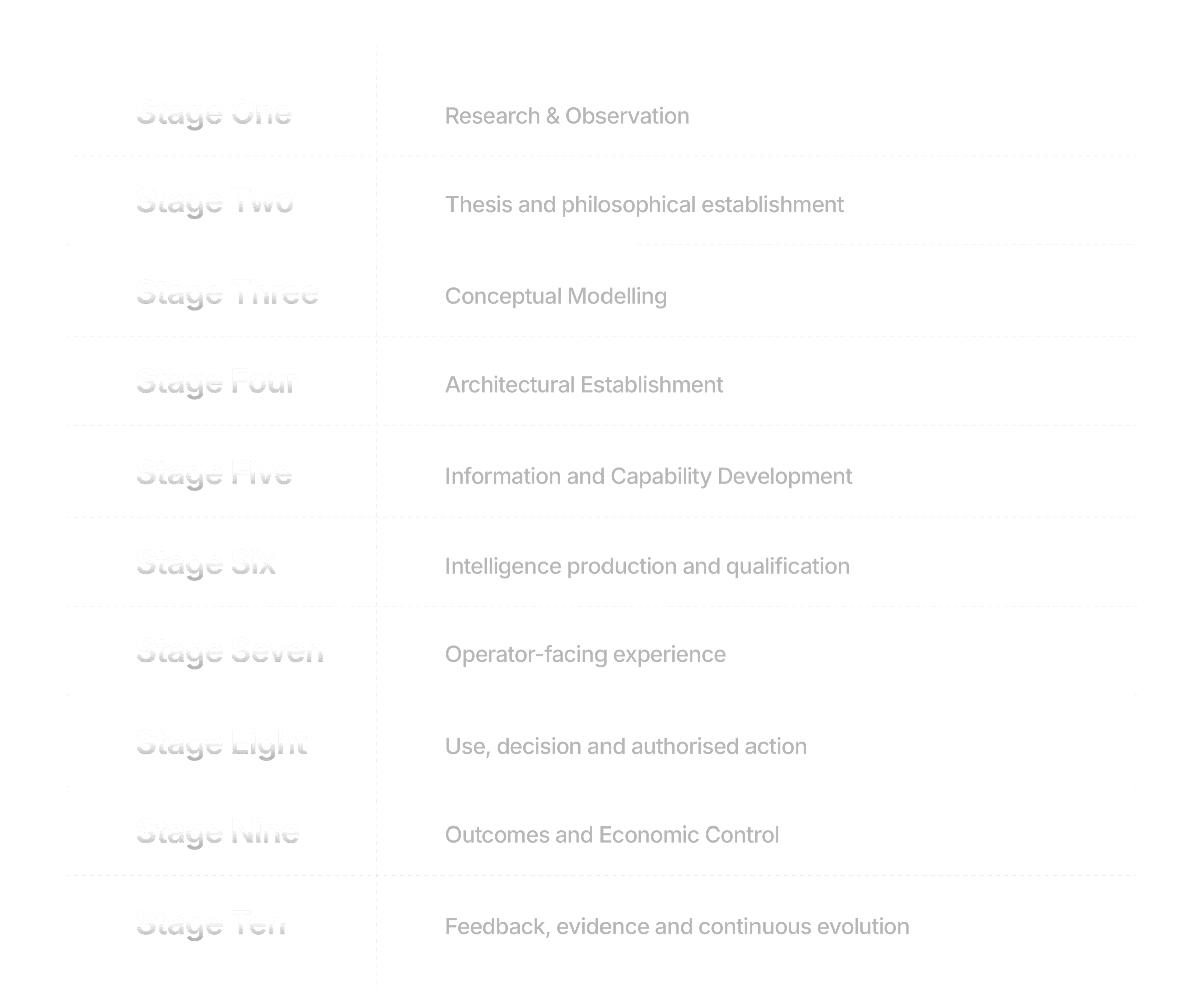
Stage One: Research and observation
Starting question: What is happening to Economic Life, and why does it matter?
Juliana begins by examining the realities of individuals and businesses, particularly the Average African Operator.
This involves understanding how people earn, work, manage money, operate businesses, fulfil obligations, coordinate responsibilities and navigate fragmented economic systems.
Research examines the economic, social, technological, infrastructural and behavioural conditions surrounding these realities.
Relevant evidence may include:
Economic participation and financial behaviour.
The structure of informal and formal economic activity.
Business operating conditions.
Access to financial and commercial infrastructure.
Digital adoption and technology usage.
Fragmentation across tools and systems.
Financial and operational constraints.
The changing expectations of economic operators.
Research establishes the external evidence and conditions that make Juliana’s thesis materially relevant.
Output: Research findings, observations, data, evidence and problem understanding.
Stage Two: Thesis and philosophical establishment
Question: What do these realities mean, and what should the next generation of economic systems make possible?
Juliana interprets its research and observations to establish a worldview.
It develops a position on the nature of Economic Life, the operator’s challenges, the limitations of fragmented infrastructure and the need for more intelligent systems.
This is where the foundational establishments emerge:
Economic Life.
Economy.
Economic Activity.
Economic Infrastructure.
Economic Intelligence.
Economic Control.
The New Economic Model.
Juliana’s institutional principles.
These establishments provide a conceptual basis for the company’s direction.
They are Juliana’s intellectual propositions. They must remain distinguishable from externally verified research findings.
Output: Founding thesis, philosophical establishments, institutional principles and conceptual definitions.
Stage Three: Conceptual modelling
Question: How can the thesis be organised into understandable models?
The philosophy is translated into frameworks that explain its dimensions, relationships and intended outcomes.
This is where the Economic Intelligence Framework becomes important.
Its three principal models provide different perspectives:
Economic Intelligence Manifestation Matrix: what intelligence can interpret.
Economic Control Model: what intelligence should help the operator achieve.
New Economic Model: how economic management can be transformed.
The models turn broad philosophical propositions into structured conceptual references.
Output: Conceptual frameworks, models, classifications and governing relationships.
Stage Four: Architectural establishment
Question: What kind of system can make the thesis operational?
The conceptual models inform the architecture of the platform.
Juliana establishes the operating environments, intelligence architecture, data structures, event foundations, context systems, authority controls and experience layers required to realise its ambition.
This is where the architecture becomes explicit:
Personal Economy and Business Economy.
Juliana Platform.
Sense.
The Tri-Force Model.
Sense Intelligence.
Sense Experience.
PersonalSense.
BusinessSense.
JMI.
SuperSense and its planned evolution.
Output: Platform architecture, intelligence architecture, data and context models, technical specifications and product-system relationships.
Stage Five: Infrastructure and capability development
Question: What must exist for the architecture to work in reality?
The architecture is translated into actual capabilities.
Juliana develops or integrates the financial, commercial, operational, trust and execution infrastructure required for its environments to function.
Examples include:
Wallets and accounts.
Funding and transfers.
Payments and collections.
Invoicing.
Products and inventory.
Orders and bookings.
Services and service management.
Customers and staff.
Websites and commercial visibility.
Permissions and authentication.
Event capture and structured records.
Context and provenance systems.
These capabilities must work reliably in their own right.
They are not treated as intelligence simply because they generate data. Their importance is that they establish the economic activity and context from which intelligence can be developed.
Output: Functional infrastructure, product capabilities, integrations, structured activity and operational records.
Stage Six: Intelligence production and qualification
Question: What can Juliana understand from the activity and context it has established?
Sense processes relevant structured activity and context to produce intelligence.
Depending on the maturity of the platform, this may involve deterministic interpretation, signal evaluation, pattern recognition, anomaly identification, contextual reasoning, prediction and recommendation.
Sense Intelligence qualifies the resulting outputs through evidence, provenance, priority, signal maturity and understandable form.
JMI helps organise and orchestrate delivery.
The level of intelligence must always correspond to what the available evidence and implemented capability can reliably support.
Output: Qualified Economic Intelligence, contextual explanations, relevant signals and supported recommendations.
Stage Seven: Operator-facing experience
Question: How does the operator receive, understand and engage with the intelligence?
The intelligence must become accessible through the platform’s user-facing experiences.
This is where Sense Experience becomes tangible.
Examples include:
PersonalSense.
BusinessSense.
Sense Insight Cards.
Sense Conversational Experience.
Sense Insight Experience.
Smart Assistant.
SenseMoment.
The experience communicates not just what the system has observed, but what the observation means and why it matters.
Output: Understandable insights, conversational explanations, relevant notifications, contextual experiences and supported next steps.
Stage Eight: Use, decision and authorised action
Question: What can the operator do differently because of this understanding?
The operator uses the intelligence to understand their position, evaluate options, make decisions and coordinate relevant activities.
Depending on platform maturity and permissions, Juliana may support:
Reviewing financial conditions.
Managing obligations.
Following up on receivables.
Responding to inventory conditions.
Coordinating business activity.
Reviewing performance.
Evaluating potential decisions.
Preparing and executing authorised workflows.
As higher-order capabilities mature, SuperSense may support more complex multi-step work within explicit authority and control boundaries.
Output: Better-informed decisions, coordinated activity and authorised execution.
Stage Nine: Outcomes and Economic Control
Question: What meaningful difference does this make in the operator’s Economic Life?
The ultimate test is the value created for the operator.
Juliana seeks to enable:
Greater Economic Awareness.
Greater Economic Clarity.
Better Economic Foresight.
Better-informed Economic Judgement.
Improved Economic Coordination.
Greater Economic Agency and Control.
Greater capacity for Economic Advancement.
These are intended outcomes, not automatic guarantees.
They must be demonstrated through actual product use, operator feedback and measurable evidence.
Output: Greater understanding, visibility, agency, coordination and capacity to pursue economic progress.
Stage Ten: Feedback, evidence and continuous evolution
Question: What has Juliana learned, and what should it improve next?
Every meaningful interaction with the platform can produce further evidence about the quality of infrastructure, intelligence and experience.
Juliana should learn from:
Data quality.
Product activation.
Operator behaviour.
Intelligence usefulness.
Accuracy and reliability.
Trust and user confidence.
Retention and continued use.
Support requirements.
Willingness to pay.
Infrastructure performance.
Regulatory and operational constraints.
This evidence informs improvements to the product, intelligence architecture, operating model and future platform generations.
The result is a continuous feedback relationship between Economic Life and the intelligence system designed to understand it.
The entire relationship can be summarised as follows:
RESEARCH AND OBSERVATION
Understanding the actual economic realities, behaviours, conditions and challenges of operators.
↓
THESIS AND PHILOSOPHICAL ESTABLISHMENT
Establishing what Juliana believes about Economic Life, Economic Infrastructure, Economic Intelligence and Economic Control.
↓
CONCEPTUAL MODELLING
Organising those beliefs into the Economic Intelligence Framework, Manifestation Matrix, Economic Control Model and New Economic Model.
↓
ARCHITECTURAL ESTABLISHMENT
Translating the philosophy into Personal Economy, Business Economy, Sense, the Tri-Force Model and the wider intelligence architecture.
↓
INFRASTRUCTURE AND CAPABILITY DEVELOPMENT
Building and integrating the financial, commercial, operational, data, trust and execution systems that make the architecture functional.
↓
INTELLIGENCE PRODUCTION
Capturing activity, interpreting context, evaluating signals and producing qualified intelligence through Sense.
↓
OPERATOR-FACING EXPERIENCE
Delivering intelligence through PersonalSense, BusinessSense, Sense Insight Cards, Sense Conversational Experience, Sense Insight Experience and other relevant surfaces.
↓
USE, DECISION AND AUTHORISED ACTION
Helping operators understand conditions, evaluate options, coordinate resources and act within their authority.
↓
ECONOMIC OUTCOMES AND CONTROL
Enabling greater awareness, clarity, foresight, judgement, coordination, agency and advancement.
↓
EVIDENCE AND CONTINUOUS EVOLUTION
Learning from actual use and outcomes to improve the infrastructure, intelligence, experience and platform.
Economic Intelligence earns its institutional meaning when it changes how the operator understands and carries Economic Life. The operator experiences the result through everyday economic conditions: money arriving and leaving, obligations approaching, assets being used, opportunities being evaluated, customers being served, staff being coordinated and businesses being expanded.
Juliana therefore translates its architecture into a complete value chain:
Layer | What it establishes | Why it matters to the operator |
|---|---|---|
Economic environment | The relevant Personal Economy or Business Economy context. | The operator works inside an environment that corresponds to the reality being carried. |
Economic infrastructure | Accounts, records, workflows, operating capabilities and permissions. | Economic activity can be performed, recorded and governed reliably. |
Structured activity | Events, states, relationships, timing, provenance and context. | The system has an intelligible representation of what is occurring. |
Economic Intelligence | Interpretation, qualification, prioritisation, explanation and reasoning. | Activity becomes meaningful rather than remaining a collection of records. |
Sense Experience | Insights, conversations, cards, notifications and contextual surfaces. | Understanding reaches the operator in a form that can be used. |
Economic action | Decisions, coordination, authorised workflows and controlled execution. | The operator can respond with greater clarity, timing and authority. |
Economic Control | Awareness, clarity, foresight, judgement, coordination, agency and advancement. | The operator gains a stronger relationship with the Economic Life they carry. |
Personal Economy: intelligence across four economic states
Personal Economy is the full personal economic environment of the operator. It carries the connected reality of what the operator earns, receives, spends, owes, invests, owns, uses, protects, plans and builds toward. Finance is foundational, but Finance is one state within a broader Personal Economy.
The Personal Economy is organised across four connected states:
Personal Economy state | What the state contains | What intelligence must understand | Everyday value |
|---|---|---|---|
Finance | Income, balances, spending, transfers, bills, obligations, cash movement and transaction activity. | Financial position, timing, variance, pressure, recurring commitments, changes and relationships between inflows and outflows. | The operator can understand what is happening to their money, what has changed and what requires attention. |
Investments | Capital deployed toward future value, opportunity, security, return or economic advancement. | Allocation, exposure, performance, liquidity, objective, risk context, time horizon and relationship to the operator’s wider position. | The operator can evaluate whether capital is aligned with goals, available capacity and future direction. |
Assets | Property, equipment, productive tools, valuables, ownership, use, maintenance and economic capacity. | What the operator owns, how it is being used, what it supports, what it costs, what it is worth and what obligations surround it. | The operator can see assets as part of an economic position rather than as disconnected possessions. |
Lifestyle | Living commitments, dependants, priorities, recurring decisions, goals, routines, affordability and the way resources are allocated to life. | The relationship between present commitments, future goals, available resources, trade-offs, pressure and personal direction. | The operator can make decisions with a clearer view of how choices affect the life they are actually carrying. |
The intelligence relationship between the states
The states produce meaning through relationship. Finance provides current movement and position. Investments express future allocation and ambition. Assets represent ownership, capacity and obligations. Lifestyle expresses the commitments, priorities and lived conditions within which economic decisions are made.
Economic Intelligence across Personal Economy therefore reasons across questions such as:
Whether current financial flows support or constrain an investment objective.
Whether an asset is producing value, creating pressure or being underutilised.
Whether lifestyle commitments are changing the operator’s available capacity.
Whether a new commitment is consistent with current obligations and future goals.
Whether a change in income, spending or asset position materially alters the operator’s wider economic condition.
Whether an investment, asset or lifestyle decision creates a future consequence that deserves attention now.
This is the breadth of Personal Economy intelligence: the movement from isolated financial visibility to a contextual understanding of personal economic position, direction and choice. PersonalSense™ is the financial domain within this wider architecture; the Personal Economy becomes more valuable as intelligence can progressively connect its four states with appropriate evidence, permissions and operator authority.
Personal Economy value chain
Everyday reality | Enabling foundation | Structured activity | Economic Intelligence | Operator experience | Economic value |
|---|---|---|---|---|---|
The operator earns, spends, saves, invests, owns, commits and plans. | Wallets, accounts, payments, transfers, records, reports and state-specific capabilities. | Flows, balances, obligations, assets, goals, transactions, timing and relationships. | PersonalSense™ and the wider Sense architecture identify changes, relationships, pressure, patterns, capacity and supported next considerations. | The operator receives state-aware insights, explanations, comparisons, conversations and relevant SenseMoments. | Greater awareness, better judgement, earlier visibility, more coherent planning and stronger personal Economic Control. |
Business Economy: adaptive intelligence across operating realities
Business Economy is the operator’s commercial and operational economic environment. It carries the connected reality through which value is offered, created, delivered, collected, staffed, governed, measured and expanded.
Business Economy is adaptive because the Average African Operator’s business reality is adaptive. The operator may be a retailer, service provider, professional, hybrid operator, artisan, creator, consultant, employer, employee, venture builder or manager of multiple ventures. These expressions may coexist, change over time or operate through separate ventures under one operator identity.
The adaptive Business Economy expressions
Business Economy expression | Operating reality | Relevant operating chain | Intelligence subject |
|---|---|---|---|
Retailer | Sells physical or digital products. | Products → catalogue → inventory → orders → payment → fulfilment → customer relationship → revenue and visibility. | Product movement, stock position, sales performance, customer demand, collections, margin conditions and growth signals. |
Service Provider | Provides services and manages bookings or delivery capacity. | Services → availability → bookings → customer commitment → delivery → payment → repeat relationship. | Capacity, booking pressure, service performance, customer activity, delivery obligations, collections and demand patterns. |
Professional | Delivers expertise through engagements, appointments or client relationships. | Professional offer → client relationship → engagement → appointment or milestone → invoice → payment → trust and continuity. | Client commitments, outstanding work, receivables, workload, delivery risk, engagement performance and professional capacity. |
Hybrid Operator | Sells products and provides services. | Products and services → orders and bookings → inventory and capacity → payments → fulfilment → unified customer relationship. | The interaction between product demand, service capacity, inventory, bookings, revenue, commitments and customer value. |
Multi-venture operator | Carries more than one venture, income stream or operating identity. | Venture contexts → separate records and permissions → shared operator identity → controlled cross-context understanding. | Venture-level performance, shared constraints, resource allocation, exposure, commitments and the relationships between operating contexts. |
Adaptive Business OS
The Adaptive Business OS is the Business Economy structure through which Juliana adapts the operating environment to the operator’s actual business expression. It provides one coherent economic operating foundation while presenting the relevant structures, modules, workflows and public-facing surfaces for the reality being carried.
Its governing principle is one Business Economy, multiple operating expressions. A retailer receives the structures required to sell and manage products. A service provider receives the structures required to manage services, availability and bookings. A professional receives the structures required to manage clients, engagements, invoices and delivery. A hybrid operator receives the connected combination of product and service operations. A multi-venture operator receives separated contexts under one controlled identity.
The adaptive structure is itself an intelligence foundation. It gives Sense access to meaningful operating context: what the operator sells, how they deliver, what is committed, what is outstanding, who is responsible, how money moves, where pressure is emerging and how one activity affects another. BusinessSense™ can therefore interpret the business as an interconnected operating economy rather than as a series of unrelated feature records.
Business Economy value chain
Everyday reality | Adaptive infrastructure | Structured operating context | Economic Intelligence | Operator experience | Economic value |
|---|---|---|---|---|---|
The operator sells, serves, books, delivers, collects, manages staff, handles customers and grows one or more ventures. | Products, services, inventory, orders, bookings, websites, invoices, payments, customers, staff, locations, permissions, reports and operational workflows, selected according to the operator expression. | Commercial and operational events linked by product, service, customer, staff, location, commitment, payment, authority and time. | BusinessSense™ interprets performance, demand, capacity, revenue, receivables, stock, workload, commitments, dependencies, risks and opportunities. | The operator receives role-relevant insights, explanations, alerts, conversations, summaries and supported next actions. | Greater visibility, less owner-dependent coordination, earlier recognition of pressure, stronger operating judgement, better allocation of effort and increased capacity to grow. |
Connected Economic Life: intelligence across environments
The operator’s Economic Life may extend across Personal Economy and Business Economy at the same time. A business decision may affect household capacity. A personal obligation may affect business timing. An asset may serve both personal and productive purposes. An investment may support business expansion. A new venture may alter income, risk and lifestyle commitments.
Juliana preserves the separation of Personal Economy and Business Economy while making their relevant relationship intelligible through governed context. Cross-economy intelligence is purpose-limited, permission-aware, provenance-linked and auditable. It helps the operator understand connected conditions without dissolving the boundaries that protect clarity, authority and trust.
The value is a more coherent view of the life the operator actually carries: distinct environments, one economic identity, relevant relationships and intelligence that respects context.
Growth, resilience and economic advancement
Economic advancement becomes more credible when the operator can see the conditions beneath an ambition. Growth may require liquidity, capacity, inventory, staff, customer demand, operational discipline, asset deployment, investment, time or a change in commitments. Sense progressively brings these conditions into an intelligible relationship.
The operator can therefore move from aspiration alone to a more qualified view of readiness, pressure, trade-off, opportunity and next action. This does not eliminate uncertainty. It gives the operator a stronger basis for navigating it.
The everyday outcome is the progression from activity to understanding, from understanding to judgement, from judgement to coordinated action and from coordinated action to greater Economic Control.
With the environments and mechanisms established, the institutional identity of Juliana can be read as one connected system rather than as a collection of products.
Institutional Discipline and Interpretation
The final discipline is governance. As terminology, architecture and capability evolve, Juliana must distinguish evidence, proposition, specification, implementation and future direction.
Research evidence versus Juliana’s propositions
External research findings should be supported by identifiable sources, data and methodology.
Juliana’s own philosophical propositions and conceptual models should be identified as institutional establishments.
A Juliana thesis should not be presented as an externally established fact merely because it is supported by the company’s internal reasoning.
Conceptual models versus implemented systems
A conceptual model explains how Juliana understands a problem or intends to organise a capability.
An implemented system is a functioning product or technical capability.
The existence of the Economic Control Model, for example, does not automatically mean that every dimension of Economic Control is already measurable or delivered by the platform.
Architectural definitions versus product experiences
Sense is an architecture. Sense Experience is an experience layer. A Sense Insight Card is a delivery mechanism.
These retain their distinct meanings.
Similarly, PersonalSense and BusinessSense are intelligence domains, while Smart Assistant and conversational experiences are interaction surfaces.
Current capabilities versus future direction
Juliana’s platform roadmap defines a progression of capabilities.
Phase 1 establishes foundational, traceable and deterministic intelligence. Phase 2 introduces deeper contextual interpretation, prediction and recommendation. Phase 3 introduces SuperSense and higher-order reasoning. Phase 4 advances adaptive orchestration and controlled automation.
Future capabilities must not be represented as current functionality.
Economic environments versus data access
Personal Economy and Business Economy are connected through the wider platform and operator identity.
This does not mean that their records, permissions or operating contexts should be indiscriminately merged.
Intelligence must respect the relevant mode boundaries, purpose limitations and authority controls.
Terminology and architectural governance
Every formal establishment should have:
An approved name.
A precise definition.
A recognised place in the institutional hierarchy.
A clear relationship to other establishments.
An identified owner or governing function where appropriate.
A documented status: established, specified, planned, implemented or under review.
This prevents conceptual duplication, terminology drift and conflicting interpretations as Juliana grows.
The Ultimate Institutional Statement
Juliana’s intellectual foundations converge around one governing direction: Economic Life should become increasingly understandable, connected and actionable through Economic Intelligence.
Juliana Systems Limited is an Economic Intelligence Company building an intelligent operating system for African Economic Life. Its research defines the economic realities at stake; its Economic Intelligence Framework defines the models; Personal Economy and Business Economy provide the operating environments; infrastructure structures activity; Sense produces qualified intelligence; and Sense Experience returns that intelligence to the operator.
PersonalSense, BusinessSense, JMI, SuperSense and the wider experience system represent the progressive depth of that architecture—from reliable understanding to cross-context reasoning, authorised execution and controlled automation.
Economic Life is what Juliana seeks to understand. Economic Infrastructure enables engagement with it. Economic Intelligence is what Juliana develops from it. Economic Control is what Juliana seeks to make more possible.
The Juliana Intellectual and Value Architecture
For institutional reference, the entire body of thinking can be condensed into the following structure.
Foundational question | Juliana’s establishment |
|---|---|
What is the subject? | Economic Life |
What is the organised environment? | Economy |
Who is at the centre? | The Operator |
What happens within that environment? | Economic Activity |
What makes activity possible and structured? | Economic Infrastructure |
What capability does Juliana seek to develop? | Economic Intelligence |
What outcome does it seek to enable? | Economic Control |
How is the intelligence proposition understood? | Economic Intelligence Framework |
What are its dimensions? | Economic Intelligence Manifestation Matrix |
What operator outcomes matter? | Economic Control Model |
What transformation is proposed? | New Economic Model |
What architecture produces the intelligence? | Sense |
How is that architecture organised? | Tri-Force Model |
What is the qualified output? | Sense Intelligence |
How does intelligence reach the operator? | Sense Experience |
What are the principal intelligence domains? | PersonalSense and BusinessSense |
How is intelligence delivery organised? | JMI |
What enables higher-order reasoning and action? | SuperSense |
What extends this into adaptive controlled operations? | Advanced SuperSense |
What makes the platform environments accessible? | Unify and Mode Switch |
What activates business operation? | Unlock Your Business |
What supports staged capability access? | Unlock Ladder |
What makes insights accessible? | Sense Insight Experience and Sense Insight Cards |
How does the operator engage conversationally? | Sense Conversational Experience and Smart Assistant |
How can contextual material be captured and used? | SenseMoment |
How does the platform create value? | Better understanding, judgement, coordination, agency and Economic Control |
Closing Position
The intellectual foundations of Juliana are not an alternative to the company’s products, infrastructure or commercial model.
They explain why those things exist, how they belong together and what they are intended to accomplish.
The company’s responsibility is to preserve the coherence of these foundations while translating them into reliable systems, useful experiences and demonstrable economic value.
The ultimate measure of Juliana’s success will not be the number of concepts it has established or the sophistication of its terminology.
It will be the degree to which its thinking becomes reality: infrastructure that works, intelligence that can be trusted, experiences that are useful and outcomes that genuinely improve the way people and businesses understand and manage their Economic Life.